The Revolution of the Gut-Brain Axis for better mental health
Your mind may hold the thoughts, but your gut holds the remote control for your mental health.
For decades, the medical world treated the mind and the body as two separate entities. If you had a stomach ache, you saw a gastroenterologist, if you felt anxious or depressed, you saw a therapist. However, as we move through 2026, the wall between these two fields has crumbled. We now know that the “butterflies” you feel when nervous or the “gut feeling” you have about a decision aren’t just metaphors—they are biological signals.
The emerging field of Nutritional Psychiatry proves that the most powerful tool for managing mental health might not be found only in a pharmacy, but in your refrigerator.
The High-Speed Data Cable: The Vagus Nerve
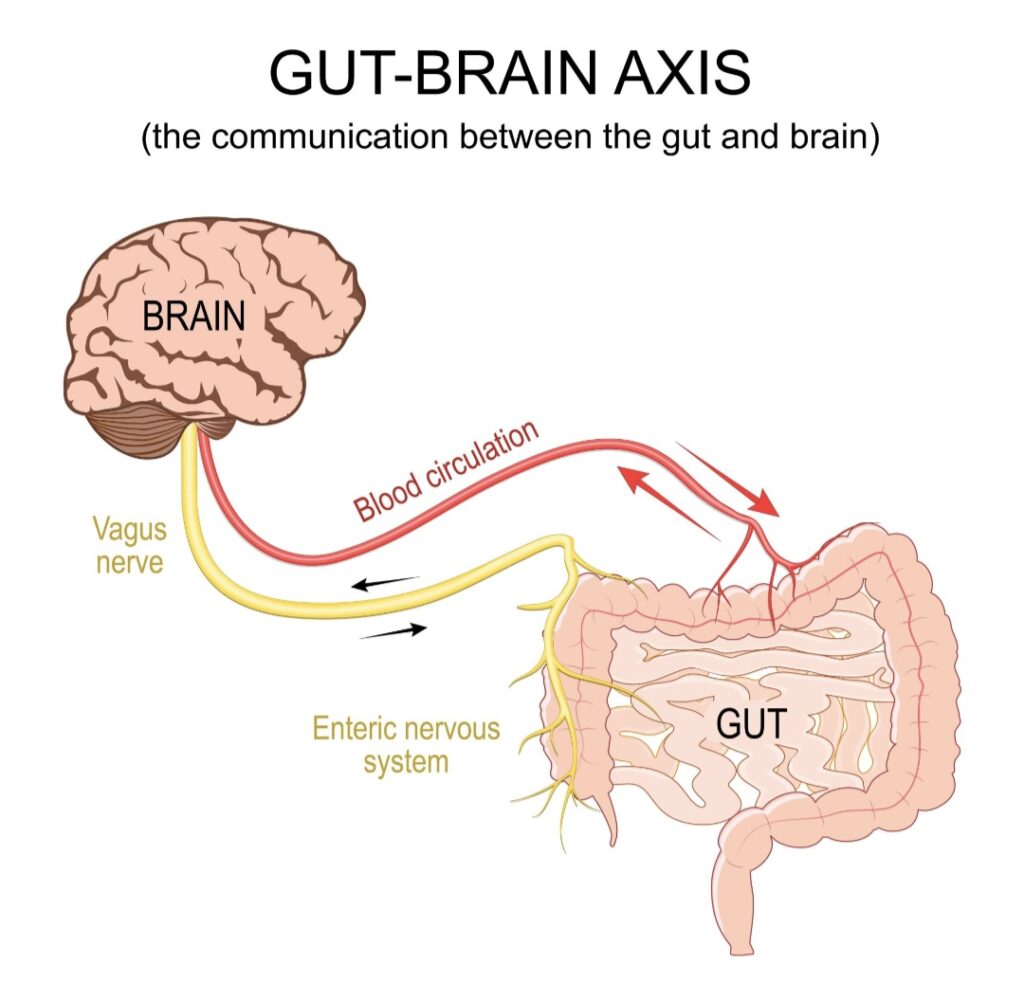
Deep within your digestive system lies the Enteric Nervous System (ENS). Containing more than 100 million nerve cells, the ENS is often called our “second brain.” It is in constant, lightning-fast communication with the brain in our skulls via the Vagus Nerve.
Think of this nerve as a bidirectional fiber-optic cable. Surprisingly, about 90% of the signals travel upward from the gut to the brain. This means your gut is constantly reporting its status to your mind, influencing your mood and focus before you even realize it.
The Serotonin Factory: Why Gut Health is Mental Health
One of the most mind-blowing facts of modern biology is where our “happiness chemicals” originate. While we associate serotonin—the neurotransmitter responsible for mood stability—with the brain, roughly 95% of your body’s serotonin is produced in your gut.
This production is managed by your microbiome, the community of trillions of bacteria living in your intestines. When your microbiome is diverse, it produces the chemical precursors your brain needs to feel balanced. When it’s out of balance (a state called dysbiosis), serotonin production falters, leading to irritability, brain fog, and increased anxiety.
The 2026 Breakthrough: Psychobiotics
The newest frontier in this field is the study of Psychobiotics. These are specific strains of “good” bacteria that, when ingested in sufficient amounts, produce a measurable benefit to mental health.
Research has shown that certain strains, such as Lactobacillus helveticus, can actually lower cortisol—the body’s primary stress hormone. In 2026, we are seeing a shift where doctors are prescribing “mood-boosting” probiotics alongside traditional talk therapy. This isn’t just about digestion anymore, it’s about biological engineering for peace of mind.
How to Eat for Mental Clarity
Eating for mental clarity is less about “superfoods” and more about stability. If your blood sugar is a roller coaster, your focus will be too. To keep your brain sharp, you want to provide it with a steady, high-quality fuel source rather than quick bursts of sugar.
The “Mental Clarity” Daily Checklist
| Category | Aim For… | Avoid… |
|---|---|---|
| Protein | Lean poultry, eggs, beans | Processed deli meats |
| Fats | Omega-3s, Olive oil | Trans fats/Fried foods |
| Carbs | Whole grains, Berries | High-fructose corn syrup |
| Beverages | Green tea, Water | Sugary energy drinks |
If the gut is the engine of our mental health, food is the fuel. To optimize this connection, we must focus on three main pillars:
1. Fermented “Mood” Foods
Fermented foods are natural probiotics. By eating things like kimchi, kefir, sauerkraut, and kombucha, you are directly “seeding” your gut with the beneficial bacteria needed to produce neurotransmitters. Studies have shown that people who consume fermented foods regularly have lower levels of social anxiety and better stress resilience.
2. Prebiotic Fiber: the Army
It isn’t enough to just add good bacteria; you have to feed them. Prebiotics are specialized plant fibers that act as food for your microbiome. You can find these in:
Garlic and Onions
Slightly under-ripe bananas
Asparagus and Jerusalem artichokes
Oats and Legumes
3. Polyphenols: The Brain’s Bodyguards
Polyphenols are antioxidants found in brightly colored plants. They help reduce inflammation in the gut. Since neuro-inflammation (inflammation in the brain) is a leading cause of depression, keeping gut inflammation low is vital. Reach for blueberries, dark chocolate (at least 70% cocoa), and green tea.
Understanding this connection empowers you. It means that managing mental health isn’t just about what we think, it’s also about how we fuel ourselves. Simple changes in diet or managing gut inflammation can sometimes be a powerful “sidekick” to traditional therapy or medication.
A Quick Reality Check: While the gut-brain link is powerful, it’s one piece of the puzzle. It’s a teammate to mental health care, not a total replacement for professional support if you’re struggling.
The answer is a resounding yes. While diet may not replace clinical intervention for severe disorders, it is the foundational floor upon which all mental health is built. You cannot build a house of mental stability on a foundation of nutritional chaos.
By prioritizing a diverse, plant-rich diet, you aren’t just improving your digestion—you are giving your mind the biological resources it needs to be resilient, focused, and calm.